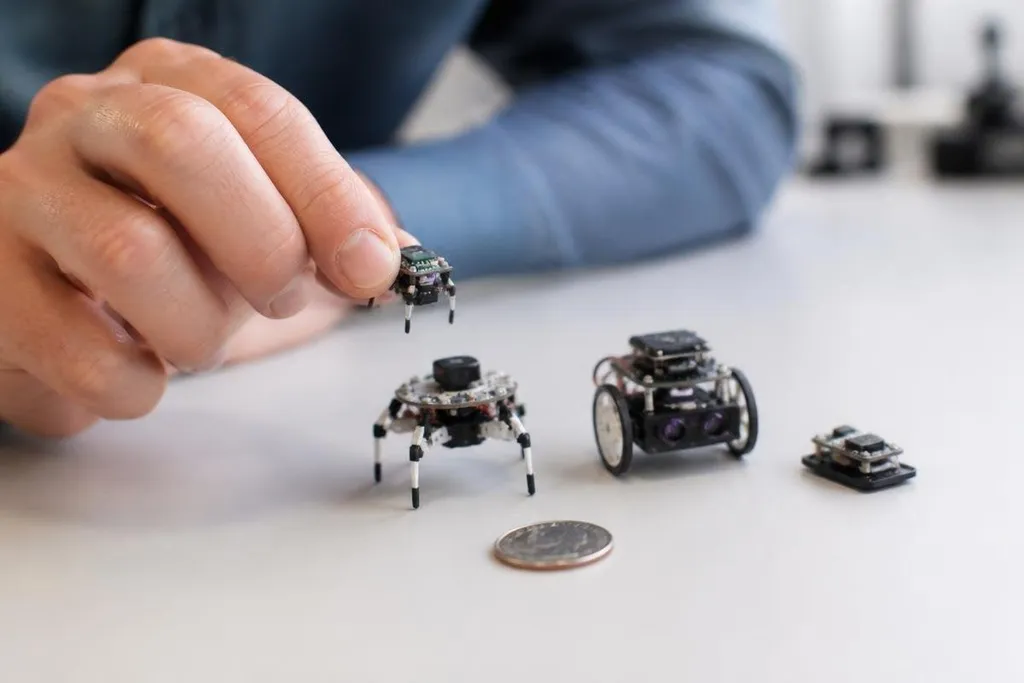
A robot can shrink until its motors, sensors, power source, and control parts stop doing useful work. The hard limit comes from physics, not from the size of the body shell.
If you’re comparing miniature robots for research or automation, these are the points that decide whether a smaller design can still do a job:
- Power gets harder: a tiny robot has less room for batteries and wiring.
- Movement changes: surface forces matter more than weight as size falls.
- Sensing gets weaker: small cameras, antennas, and sensors collect less information.
The size of the robot is only part of the problem
Four systems must work together: movement, sensing, control, and power. Shrinking one part puts pressure on the other three, because each system needs space, connections, and a way to lose heat.
The body can become smaller than the parts that move it. A motor still needs a coil, magnets, bearings, and a control circuit.
A camera still needs a lens and a sensor. A radio still needs an antenna that works at its chosen frequency.
That makes the smallest useful robot a design problem, not a simple matter of reducing every measurement. Engineers may remove a motor and move the robot with vibration, magnetic force, light, or a change in surface tension. Each choice gives the robot a new limit.
Why small robots stick to surfaces
Weight falls faster than surface area as an object shrinks. That changes how the robot interacts with dust, water, walls, and other objects. At a larger size, gravity usually dominates. At a smaller size, adhesion, surface tension, and static electricity can matter more.
This is why a miniature robot may struggle to leave a surface after landing. Its feet can stick, its body can collect dust, and a thin film of water can block movement. The same forces can help a wall-climbing robot hold position, but only on surfaces that match its feet or gripper.
Air also behaves differently around tiny moving parts. A small wing or rotor moves very little air, so flight needs careful control and a steady power source. A robot that swims through liquid faces a similar problem: viscosity makes the fluid feel thicker at small sizes.
Power and control set the working limit
Battery size is often the first practical limit. A smaller battery stores less energy, while the robot still needs power for movement and sensing. Wireless power can remove the battery, but it ties the robot to a field, a nearby transmitter, or a controlled test area.
Control can become harder too. A large robot can carry a computer and several sensors. A tiny robot may need control signals from an external computer, which makes it partly dependent on a camera, cable, magnetic field, or radio link outside the body.
That difference matters for your use case. A robot that follows commands inside a lab may work well without onboard computing. The same design may fail in a dark space, behind an obstacle, or anywhere its control link gets blocked.
That control limit makes the test record more useful than a polished clip. Robot24.com reporting on small robots can tie a named machine’s size and power use to the task it actually completed. The next section looks at the jobs tiny robots can handle.
What tiny robots can do well
Small size makes sense when the robot must enter a narrow space, work near delicate material, or move through a fluid. It also cuts the amount of material needed for the body, though the control and power equipment may remain outside.
Useful jobs include inspection inside small gaps, medical research, environmental sensing, and experiments that need many small units. The task must fit the robot’s limits. A tiny robot may collect a signal or change position, but it probably can’t carry a large load, work for long periods, or make decisions without outside help.
I’d judge a miniature robot by the task it completes, not by its smallest published dimension.
A practical check before you choose one
Use this list before treating a small robot as a useful tool:
- Name the task: write down the object it must move, inspect, sense, or change.
- Check the power path: find out whether the robot carries a battery or receives power from outside.
- Map the control link: note the required range, line of sight, cable, magnetic field, or radio signal.
- Test the surface: check dust, moisture, roughness, and adhesion where the robot will move.
- Measure the result: decide what counts as success, such as a sensor reading, a completed route, or a repeatable grip.
The smallest robot that works is usually more useful than the smallest robot that moves once. The open question is how much sensing and power engineers can fit into that shrinking space without handing control back to the room around it.